
GER
HELENA HAFEMANN
BIRDS OF PREY
MARCH 21–MAY 13, 2026
OPENING: MARCH 20, 7–9 pm
CLOSED: APRIL 3–6, 2026
SPECIAL OPENING HOURS: MAY 1–3 (TBA)
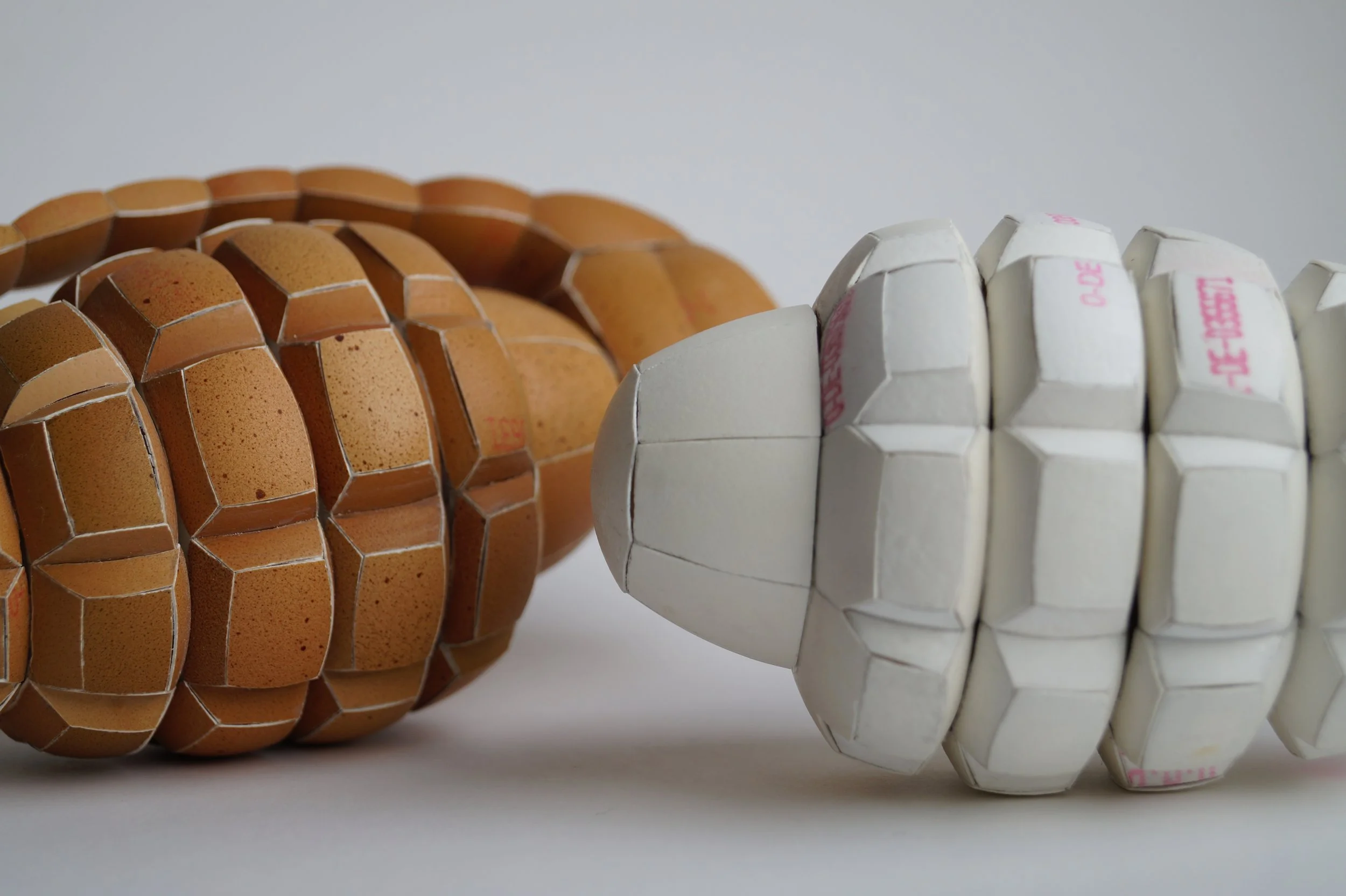
Helena Hafemann, Kollateral, 2026
With Birds of Prey, Jarmuschek + Partner presents the artist Helena Hafemann’s second solo exhibition at the gallery. By artistically altering, repairing, or transforming objects from our everyday world, Helena Hafemann continually surprises viewers of her work. She approaches those things that previously had a fixed place, were clearly assigned to utilitarian realms, or were subject to traditions in an unconventional and unadorned manner. With a keen sense of symbolism, subtlety, and fundamental social issues, she reveals what is conceivable beyond these taken-for-granted assumptions and facilitates an unexpected shift in perspective.
Helena Hafemann’s most important artistic ingredient connects all her works and is, at the same time, physically invisible: time. Though it cannot be influenced, it can still be captured—as memories or traces of change. Over the past few years, the artist has painstakingly and persistently crocheted numerous time capsules. Even the first of the red-and-white pills made of scrub sponge wool was not only, but also a visualization of the lifetime she had invested. The gigantic version, now on view for the first time at Jarmuschek + Partner gallery, has, in keeping with its size, undergone a longer development phase—and not just in terms of its creation process. The capsule shakes, it buckles like a bull gone wild, as if it wanted to shake off a pesky rider. And much more than just time clings to the red pill: since the turn of the millennium, it has been used repeatedly as a symbol of supposed truths. In the groundbreaking film The Matrix (1999), the main character chooses to take the red pill and thereby gains insight into the true, deeply dystopian world, in the face of pain, loss, and struggle. In our world, the red pill has since become a symbol of a movement. Through blogs, forums, and social media, the manosphere has emerged—a subculture where misogyny, conspiracy theories, and ideals of self-optimization converge*. It is no coincidence that Helena Hafemann’s Rodeo seems to shake off all these associations on a machine where a cowboy would typically attempt to tame a bull. This pill doesn’t make things easy for the patriarchy. At the same time, all the attributed memories, truths, and symbolism seem to be mixed together within it, as if in a cocktail shaker. This, too, may serve as a metaphor for the media status quo and an era full of fake news and timelines.
Helena Hafemann’s wild crochet ball doesn’t promise quick fixes, but the artist does possess a certain expertise when it comes to mending: Having already patched up numerous cracked decorative plates with long strands of yarn in series such as Fadenschein and Hunter and Game, she now turns her attention to a broken sink. Where water once flowed, a patina of dust and grime now bears witness to how long this state of destruction has already persisted. Helena Hafemann creates no illusion for her audience, wipes nothing away, and leaves the damage visible. Yet with the abstract white, flowing thread connections between the individual parts, she manages to create an impression of healing and growing together—melancholic and comforting at the same time.
While many of the ceramic shards Helena Hafemann works with likely resulted from simple gravity, in other works the artist explores the traces of violence: as early as 2022, she presented old shooting targets featuring carefully stitched, scarred bullet holes. In the works of her latest series, Kollateral, expressions of brutality and fragility in form and material—powerful images of life and death—are also inextricably interwoven: using plaster models, the artist has constructed a series of hand grenades from the shells of variously colored organic eggs. They convey a threat and a foreboding of the absurdly simultaneous destruction of the objects themselves as well as the surrounding environment. Each eggshell fragment is precisely and meticulously tailored in its form to the next grenade segment. There is a lot of time in this, too. And perhaps a little hope that the trigger won’t be pulled after all.
Helena Hafemann was born in Wiesbaden in 1997 and studied Fine Art at the Mainz Academy of Fine Arts and Art History and Ethnology at Johannes Gutenberg University Mainz until 2023. Her work has been exhibited among others at the Nassauischer Kunstverein, the International Festival of Ephemeral Art in Sokolowsko, Poland, and the exhibition Let Them Weave at Studio Cannaregio during the Venice Biennale. In 2020, she showed her works in her first solo exhibition at Kunstraum Wiesbaden, followed by presentations at the Opelvillen in Rüsselsheim (solo), the Ausstellungshaus Spoerri in Vienna, the Amtsalon Berlin (solo), the Neuer Kunstverein Gießen (solo), and the Kunsthalle Mainz, as well as in numerous other exhibitions and at fairs in Europe, New York, Toronto, and Sydney. Just recently, three works by Helena Hafemann were acquired by the art collection of the German Bundestag.